
Desks & space
Best small-space standing desk for a walking pad
A walking pad makes a small room’s clearances matter twice. Measure the desk, pad, chair, and step-off path together so the compact setup still leaves enough room to move around it without blocking the doorway.
Measure pad depth, desk width, chair route, and finished height together before buying.
Apartment workers pairing a compact sit-stand desk with an under-desk pad.
A desk can fit the pad while still leaving a cramped cable, chair, or step-off path.
Our take is based on published specifications and linked sources. We have not hands-on tested these products. Some links may earn a commission.
Buying links, offers & research notes Expand
A closer look
Start with the room footprint
These quick picks show the smallest listed surface, a documented configurable frame, and a live 48 × 24-inch affiliate option. Confirm the exact top, base, pad body, walking lane, and finished keyboard height before ordering.
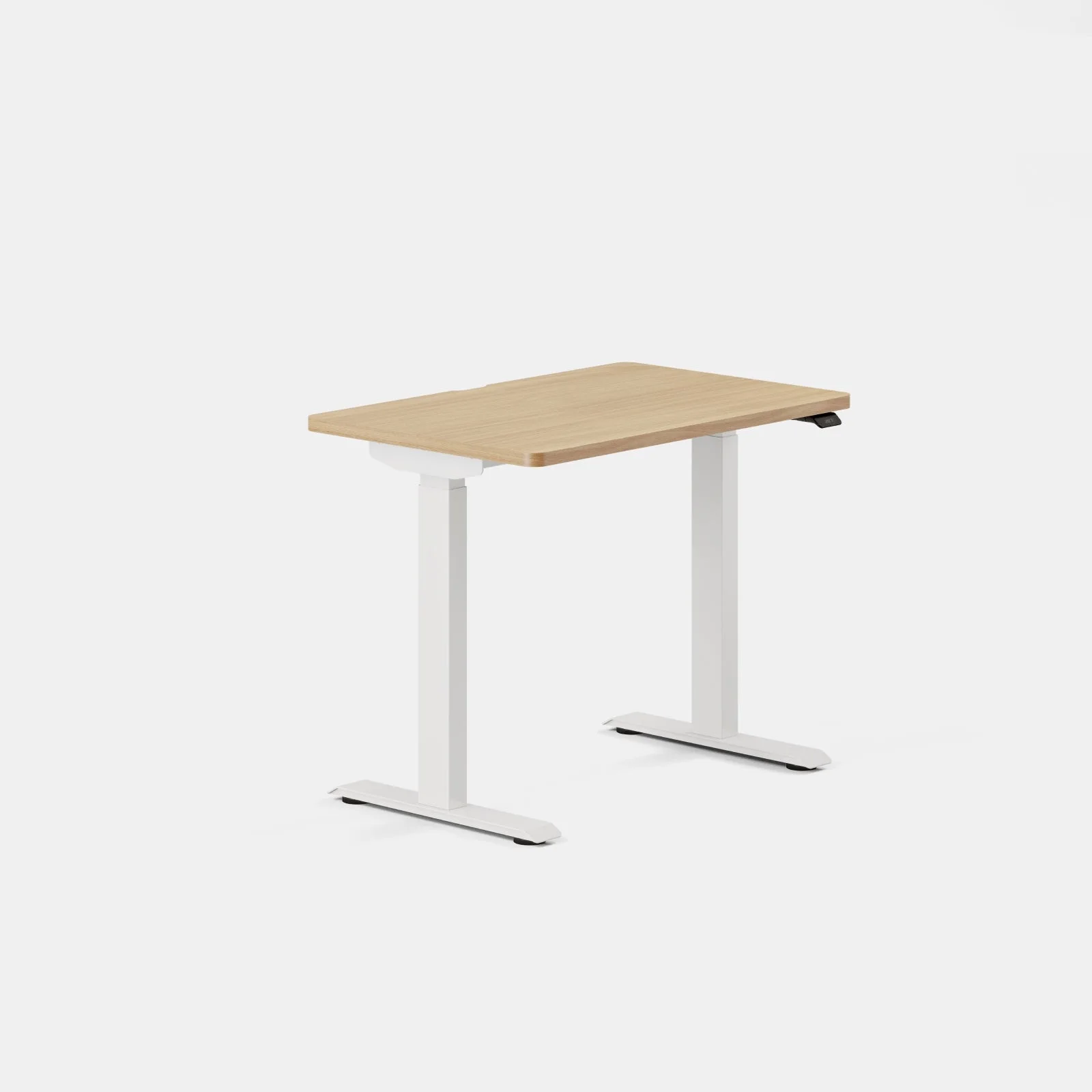 Photo: manufacturer
Branch Duo Standing Desk — 36 × 24 in
Branch
Smallest listed top
36 × 24 in · 28–47.3 in desk range
Official specs checked September 3, 2026
See current price Photo: manufacturer
UPLIFT V3 2-Leg Frame + 42 × 24 in Top
UPLIFT Desk
Shallow-top profile
42 × 24 in top · 22.6–48.7 in with 1-in top
Official specs checked September 3, 2026
See current price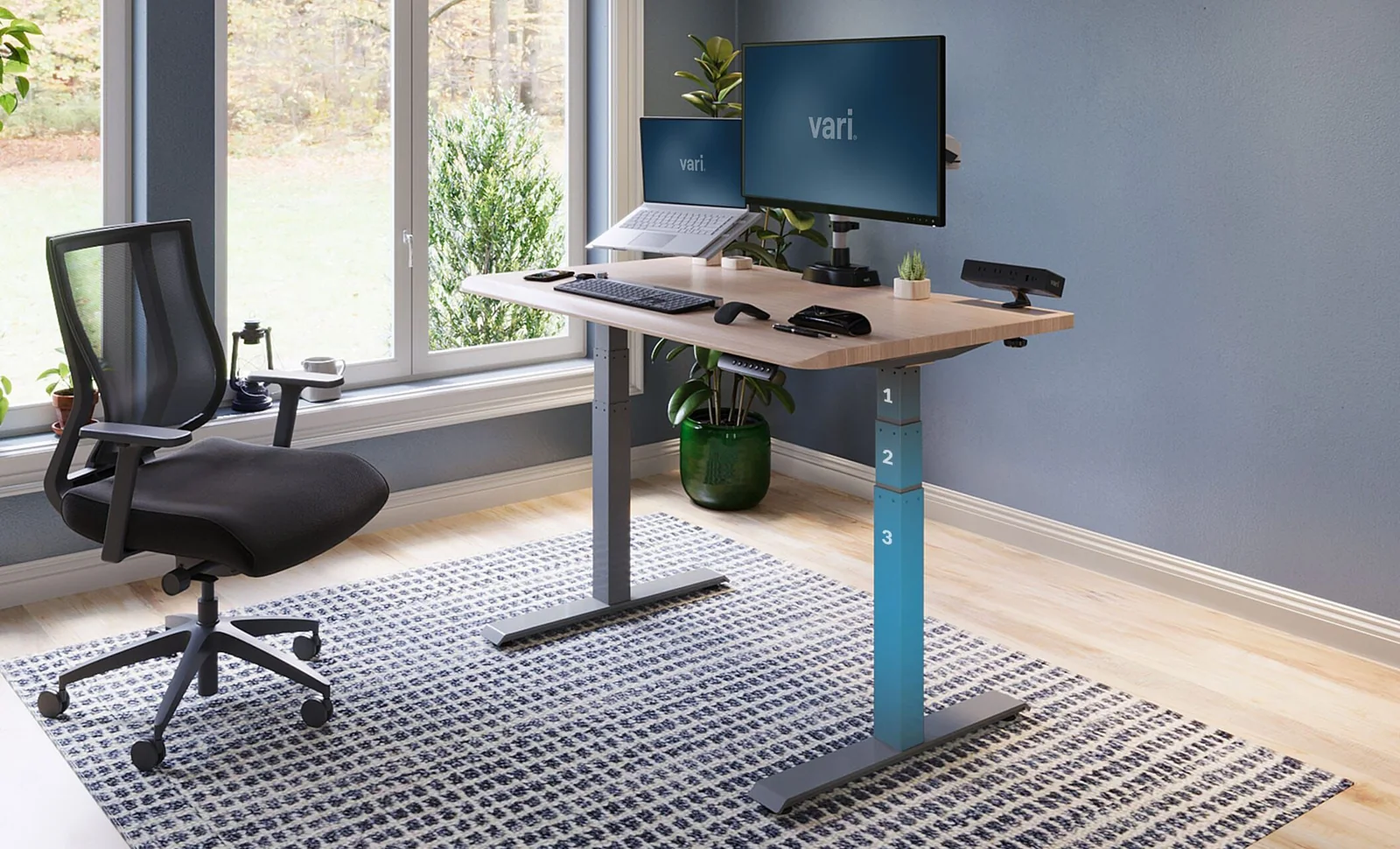 Photo: manufacturer
FEZIBO Standing Desk — 48 × 24 in, Maple
FEZIBO
PartnerBoost catalog · shallow top
48 × 24 in · height/base still to verify
Official specs checked September 8, 2026
See current price1. Measure the pad
Use the full machine body, not only the walking belt: width, length, deck height, and stop-control access.
2. Measure the desk
Record finished keyboard height, desktop depth, base span, feet, crossbars, and where the cable must move.
3. Draw the route
Mark the side walking lane, front and back exit, outlet, doorway, hallway, and storage position before checkout.
Run the desk-height calculation first
The 24-inch desk that fits your floor can still fail if the top cannot reach your keyboard target over the pad.
Fit-first shortlist
The smallest top is not automatically the best room plan.
Branch Duo is the smallest published top here. UPLIFT offers the widest set of published height and frame choices around a 24-inch top. Vari reduces assembly variables with its pre-installed frame, but its 48 × 30-inch footprint takes more depth. FEZIBO adds a live 48 × 24-inch affiliate option whose height, base, and cable fields remain unresolved. The ranking changes if your limiting constraint is height, floor depth, a turn in the doorway, or the cable route.
| Model | Desktop | Height / basis | Frame / real footprint | Pad side / front / back | Load | Warranty / returns |
|---|---|---|---|---|---|---|
| Branch Duo (36 × 24) | 36 × 24 in selected top; 48 × 24 and 58 × 27 in options also listed | 28–47.3 in Branch lists this as the assembled desk height for the selected size; top thickness/deck-to-floor measurement is not separately stated on the product page. | Frameless design; inner leg clearance and assembled frame footprint: Unknown | Side / front / back gap: Unknown. Branch does not publish a universal walking-pad clearance. Use the pad body dimensions and its manual, not the 36-inch top alone. | 275 lb weight limit | 10 years for Duo Standing Desk. 30 days for like-new furniture in original packaging; desks are subject to a return label fee. Confirm the current fee and eligibility before ordering. |
| UPLIFT V3 2-Leg + 42 × 24 | 42 × 24 in top selected separately; 48, 60, 72, and 80 × 24 in options also listed | 22.6–48.7 in with a 1-in desktop UPLIFT publishes a 21.6–47.7-in frame range without the top; its 22.6–48.7-in desk range assumes a 1-in desktop. Recalculate for another top thickness. | Official frame span 41.3–72.2 in; 23.6-in frame depth for a 24-in desktop. This is frame span/depth, not a published inner-leg clearance. | Side / front / back gap: Unknown. The C-Frame is recommended by UPLIFT to maximize under-desk space, but it does not establish a safe pad gap or replace the pad manual. | 355 lb lifting capacity, inclusive of desktop weight | 15-year UPLIFT warranty. 30-day risk-free trial for like-new products in original packaging; UPLIFT says it covers return shipping in the contiguous US. Confirm exceptions for the chosen top. |
| Vari ComfortEdge (48 × 30) | 48 × 30 in; the same official page also lists 40 × 26 and 54 × 26 variants | 25–50.5 in Vari lists 25–50.5 in as the product height range, with a 1¼-in desktop. Treat it as the manufacturer’s assembled desk range, not a measured keyboard height. | One-piece pre-installed frame; inner leg clearance and real assembled frame footprint: Unknown on the product page. | Side / front / back gap: Unknown. A 48 × 30 top is not proof of small-room fit; compare the pad body and walking route against the full base and wall position. | 220 lb weight capacity | Lifetime, non-transferable warranty. Free returns within 30 days are stated on the current US product page; contact Vari to arrange a return. Confirm the current variant terms. |
| FEZIBO (48 × 24) | 48 × 24 in selected Maple listing | Exact finished minimum / maximum: Unknown The selected listing title confirms electric height adjustment but does not provide the finished range used by this fit comparison. Obtain the current range before checkout. | Electric height-adjustable desk; inner-leg clearance, feet, crossbar position, and assembled frame footprint: Unknown in the current catalog listing. | Side / front / back gap: Unknown. The 48 × 24 top does not establish walking-pad clearance; compare the full pad body with the assembled base before ordering. | Unknown in the current catalog listing | Verify current seller warranty. Verify the exact Amazon seller, delivery promise, and return terms shown for the selected variant before ordering. |
“Unknown” is intentional: the cited manufacturer page did not publish a field. Pad clearance is a planning input, not a generic number we can safely invent. Frame span is not the same as inner-leg clearance.
Branch Duo Standing Desk — 36 × 24 in
Smallest desktop option in this comparison
- Desktop / top
- 36 × 24 in selected top; 48 × 24 and 58 × 27 in options also listed
- Desk height
- 28–47.3 in
- Maximum load
- 275 lb weight limit
- Frame / feet
- Frameless design; inner leg clearance and assembled frame footprint: Unknown
- Pad clearance
- Side / front / back gap: Unknown. Branch does not publish a universal walking-pad clearance. Use the pad body dimensions and its manual, not the 36-inch top alone.
- Power / cable loop
- Optional Clamp-On Power and Cable Organizer are listed. Outlet count, cable-loop radius, and an exact rear cable path: Unknown.
Official height basis
Branch lists this as the assembled desk height for the selected size; top thickness/deck-to-floor measurement is not separately stated on the product page.
Move and storage route
Product page lists two packages; the 36-inch top package is 39 × 27.2 × 3 in and the second package is 32.4 × 12.7 × 8.1 in. Doorway and assembled-room route: measure your own path.
Warranty and returns
10 years for Duo Standing Desk. 30 days for like-new furniture in original packaging; desks are subject to a return label fee. Confirm the current fee and eligibility before ordering.
Why consider it
The 36 × 24 option has the smallest published desktop envelope in this comparison while retaining electric height adjustment. Check it first when the room is constrained on width and depth.
Why skip it
The 47.3-inch maximum is the tightest height ceiling here. If your standing keyboard target plus pad deck is near that number, a smaller top does not rescue the fit.
Evidence boundary: Current Branch US product-page evidence: 36 × 24, 48 × 24, and 58 × 27-inch options; 28–47.3-inch height; 275-lb limit; two presets; 10-year warranty; <50 dB operating-noise claim; and two listed shipping packages. No hands-on desk, walking-pad, noise, stability, or typing test is claimed. “Unknown” means the cited official source did not publish the field.
Official source trail
Manufacturer product listings are counted as merchant clicks; warranty and return-policy references are not.
UPLIFT V3 2-Leg Frame + 42 × 24 in Top
Best height and frame tuning for a 24-inch top
- Desktop / top
- 42 × 24 in top selected separately; 48, 60, 72, and 80 × 24 in options also listed
- Desk height
- 22.6–48.7 in with a 1-in desktop
- Maximum load
- 355 lb lifting capacity, inclusive of desktop weight
- Frame / feet
- Official frame span 41.3–72.2 in; 23.6-in frame depth for a 24-in desktop. This is frame span/depth, not a published inner-leg clearance.
- Pad clearance
- Side / front / back gap: Unknown. The C-Frame is recommended by UPLIFT to maximize under-desk space, but it does not establish a safe pad gap or replace the pad manual.
- Power / cable loop
- Includes a FlexMount Cable Manager and 10 mounted cable wraps. Outlet count and the required cable-loop radius while the desk moves: Unknown; plan the loop before fixing the desk position.
Official height basis
UPLIFT publishes a 21.6–47.7-in frame range without the top; its 22.6–48.7-in desk range assumes a 1-in desktop. Recalculate for another top thickness.
Move and storage route
Frame and desktop are selected as separate components, which can make a narrow doorway or stair turn easier to plan. Assembled route, package sizes, and storage footprint for the exact top: Unknown on the cited frame page.
Warranty and returns
15-year UPLIFT warranty. 30-day risk-free trial for like-new products in original packaging; UPLIFT says it covers return shipping in the contiguous US. Confirm exceptions for the chosen top.
Why consider it
The 24-inch depth keeps the top shallow while the V3 frame offers the highest published maximum height in this set. The C-Frame option and included cable manager give more variables to plan around a pad and wall outlet.
Why skip it
This is a frame-plus-top project, not the lowest-friction boxed desk. The 42 × 24 top still needs a room-level pad width/length check, and a 24-inch top can run out of monitor or keyboard depth faster than its floor footprint suggests.
Evidence boundary: Current UPLIFT US V3 frame-page evidence: 22.6–48.7-inch published desk range; 42 × 24-inch top option; C-Frame/T-Frame choices; 41.3–72.2-inch frame span; 23.6-inch depth for a 24-inch desktop; 355-lb lifting capacity; FlexMount Cable Manager; and 10 cable wraps. No hands-on desk, walking-pad, noise, stability, or typing test is claimed. “Unknown” means the cited official source did not publish the field.
Official source trail
Manufacturer product listings are counted as merchant clicks; warranty and return-policy references are not.
Vari Electric Standing Desk with ComfortEdge — 48 × 30 in
Best simple assembled desk when depth is available
- Desktop / top
- 48 × 30 in; the same official page also lists 40 × 26 and 54 × 26 variants
- Desk height
- 25–50.5 in
- Maximum load
- 220 lb weight capacity
- Frame / feet
- One-piece pre-installed frame; inner leg clearance and real assembled frame footprint: Unknown on the product page.
- Pad clearance
- Side / front / back gap: Unknown. A 48 × 30 top is not proof of small-room fit; compare the pad body and walking route against the full base and wall position.
- Power / cable loop
- Rear indentation for cable management and cable wraps are listed. Outlet count, cable-tray compatibility, and moving-loop dimensions: Unknown.
Official height basis
Vari lists 25–50.5 in as the product height range, with a 1¼-in desktop. Treat it as the manufacturer’s assembled desk range, not a measured keyboard height.
Move and storage route
Product weight is listed as 109.85 lb for 48 × 30. Vari says products may ship in multiple pieces, but the assembled doorway route and storage footprint are not published: Unknown.
Warranty and returns
Lifetime, non-transferable warranty. Free returns within 30 days are stated on the current US product page; contact Vari to arrange a return. Confirm the current variant terms.
Why consider it
The pre-installed one-piece frame reduces assembly decisions, and 50.5 inches is the highest published maximum in this comparison. The page also offers a 40 × 26 variant if that exact selection remains available.
Why skip it
The 48 × 30 option consumes more floor depth than the two 24-inch alternatives and weighs 109.85 lb. In a room where the pad already uses the walking lane, this may be the wrong “compact” assumption.
Evidence boundary: Current Vari US product-page evidence: 48 × 30-inch dimensions; 25–50.5-inch height; 220-lb capacity; 109.85-lb product weight; 1¼-inch desktop; four programmable settings; rear cable-management indentation; lifetime warranty; and 30-day free returns. No hands-on desk, walking-pad, noise, stability, or typing test is claimed. “Unknown” means the cited official source did not publish the field.
Official source trail
Manufacturer product listings are counted as merchant clicks; warranty and return-policy references are not.
FEZIBO Standing Desk — 48 × 24 in, Maple
PartnerBoost catalog option with an exact shallow surface
- Desktop / top
- 48 × 24 in selected Maple listing
- Desk height
- Exact finished minimum / maximum: Unknown
- Maximum load
- Unknown in the current catalog listing
- Frame / feet
- Electric height-adjustable desk; inner-leg clearance, feet, crossbar position, and assembled frame footprint: Unknown in the current catalog listing.
- Pad clearance
- Side / front / back gap: Unknown. The 48 × 24 top does not establish walking-pad clearance; compare the full pad body with the assembled base before ordering.
- Power / cable loop
- Controller, cord length, cable-routing hardware, outlet count, and full-height cable loop: Unknown in the current catalog listing.
Official height basis
The selected listing title confirms electric height adjustment but does not provide the finished range used by this fit comparison. Obtain the current range before checkout.
Move and storage route
Package dimensions, assembled weight, doorway route, and storage footprint: Unknown in the current catalog listing.
Warranty and returns
Verify current seller warranty. Verify the exact Amazon seller, delivery promise, and return terms shown for the selected variant before ordering.
Why consider it
The selected US listing provides an exact 48 × 24-inch surface and was shown in stock in the approved FEZIBO PartnerBoost catalog. It is a practical live-price check when a 30-inch-deep top consumes too much room.
Why skip it
Do not buy from surface dimensions alone. Skip until the finished height, base clearance, load label, cable route, warranty, and return path are confirmed for this exact ASIN.
Evidence boundary: Current approved PartnerBoost catalog evidence: FEZIBO ASIN B0F8MHPVPH, 48 × 24-inch Maple listing, electric height adjustment, in-stock status, and 10% attribution. WorkChoose has not independently verified the remaining fit fields. No hands-on desk, walking-pad, noise, stability, or typing test is claimed. “Unknown” means the cited official source did not publish the field.
Official source trail
Manufacturer product listings are counted as merchant clicks; warranty and return-policy references are not.
Room mock-up worksheet
Draw the setup at full size before ordering.
Copy this into a note, or fill it in on screen. Complete it for one exact pad and one exact desk variant. If a line is Unknown, do not turn “compact” into a guess.
A. Floor envelope
B. Height and work surface
C. Outlet and cable loop
D. Move and storage route
Why consider a small-space standing desk?
- • A shallow top can preserve a walking lane when the base and pad are measured together.
- • Height adjustment can solve the extra deck height that makes a fixed desk too low.
- • A frame with known depth or a separable top can make a doorway and storage plan easier to draw.
- • Cable management belongs in the floor plan: a moving desk needs slack without a trip loop.
Why skip the purchase for now?
- • Your calculated standing keyboard target is above the desk’s published maximum.
- • The pad blocks the only exit, the stop-control side, or a required manual clearance.
- • The base footprint is Unknown and the room depends on a few inches of unmeasured space.
- • The cable loop crosses the walking lane or cannot reach the outlet through the full travel.
Main standing-desk guide
Compare height, stability, and fit-first desk choices.
Read nextApartment walking-pad guide
Separate footprint, storage, and floor-noise constraints.
Read nextDesk-height calculator
Calculate the keyboard target after the pad raises your feet.
Read nextBranch Tria vs Duo
Compare Duo’s compact 36-inch top with Tria’s broader height range.
Read nextUnder-desk setup hub
Start with the full system: pad, desk, monitor, floor, and room.
Read nextDual-monitor standing desks
Check desktop depth, arm-clamp clearance, load, and high-position stability for two screens.
FAQ
Small-space fit questions
What is the best standing desk for a small space with a walking pad?
Start with the smallest top that still passes your height and equipment checks. Branch Duo has the smallest published option at 36 × 24 inches; UPLIFT V3 can be configured with a 42 × 24-inch top and has a taller published range; Vari ComfortEdge is a simpler assembled option but its 48 × 30-inch version needs more floor depth. None is a universal winner without your pad dimensions and standing keyboard height.
Is a narrow standing desk automatically compatible with a walking pad?
No. Desktop width and depth do not reveal the space between feet, crossbars, or the wall. Compare the pad body width and length, the desk base, the walking lane, and the movement path. A narrow top can still create a blocked or unstable room layout.
How much clearance should a walking pad have around a standing desk?
There is no single universal number to invent here. Use the exact walking-pad manual for required access and operating clearance, then add the side, front, and back space you need to walk, turn, reach the stop control, and move the pad. Enter those numbers in the worksheet before choosing the desk.
Does a 24-inch-deep desk leave enough room for a monitor and keyboard?
It may, but the pad does not change the desktop depth requirement by itself. Measure the monitor stand or arm, keyboard, wrist position, and rear cable loop. A 24-inch top saves floor depth, yet can become crowded if equipment must sit on the desktop rather than on a wall or arm.
What height should I look for when I use a standing desk over a walking pad?
Measure your standing elbow or keyboard height on the actual pad, then compare it with the manufacturer’s published desk range. Include the pad deck, footwear, keyboard thickness, and a small adjustment margin. The listed desk height is not automatically a deck-to-keyboard measurement.
How should I plan the power cord and cable loop?
Place the desk in its final position, identify the outlet, and leave a slack loop that follows the manufacturer’s moving-cable guidance without touching the pad or becoming a trip hazard. A cable organizer or rear indentation does not tell you the outlet count or loop radius; those remain setup measurements.
Manufacturer specifications and policies are time-sensitive. The linked official pages control for your exact US variant, top thickness, seller, and delivery region.

