
Walking while working
Quiet walking pads for apartments: what dB claims miss
A single decibel figure rarely predicts what a neighbor or housemate hears. Put motor claims beside floor type, impact, pace, belt care, and room construction before expecting a quiet apartment setup in your own building.
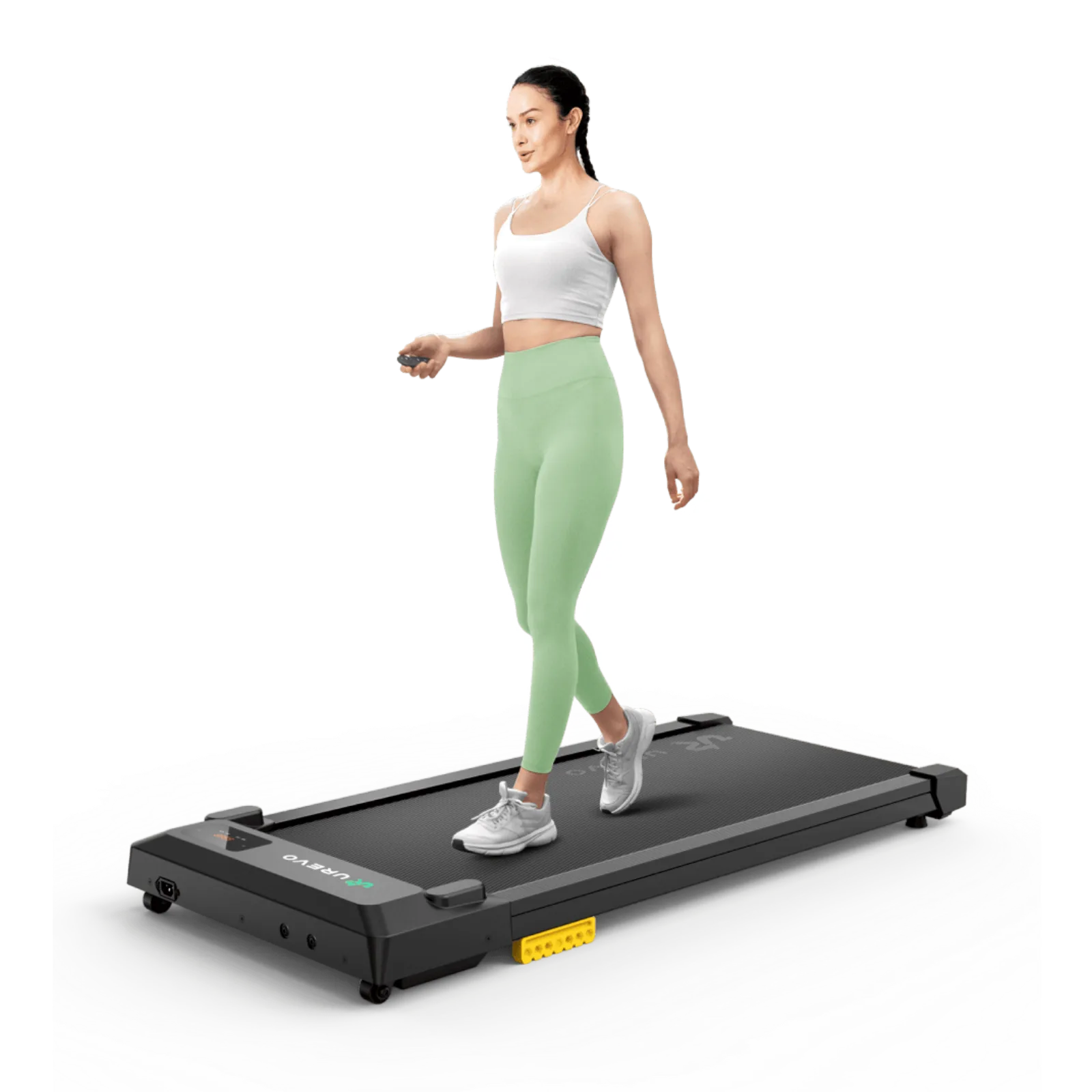
Treat “quiet” as a full floor-and-pace setup question, not a single number.
Apartment users who need to manage sound during desk walking or evening exercise.
Footfall, floor structure, belt condition, and room acoustics can dominate motor noise.
Our take is based on published specifications and linked sources. We have not hands-on tested these products. Some links may earn a commission.
Start with the floor
A dB number is air sound; it does not describe every vibration path through a building.
Measure the fit
Measured belt-surface height, total width, belt length, and storage opening decide whether “compact” works in your room.
Then choose the pace
A lower minimum speed gives more choice for keyboard work, but does not make a setup automatically quiet.
Your apartment answer starts with four measurements
Get the measured belt-surface height, clear desk width, belt length, and storage opening before you compare “quiet” wording.
The noise anatomy
Three sounds can reach three different places.
“Noise” is not one output from a treadmill. The same machine can sound acceptable in your room while still producing a vibration that is noticeable through a hard floor or connected structure. That is why a single dB claim cannot stand in for an apartment test.
Motor hum
A steady electrical or mechanical sound from the drive system. A manufacturer dB statement may be intended to describe this or the machine as a whole, but the page must say how and where it was measured before the number is comparable.
What it can sound like: Usually heard in the room as a continuous tone that rises with speed or load.
Belt + footfall
The belt, rollers, seams, footwear, and each step create a changing sound. Speed, stride, belt tension, and the person walking can matter as much as the motor label.
What it can sound like: Usually heard as repeating impacts, slaps, or a soft rolling pattern rather than one constant hum.
Structure-borne vibration
Low-frequency movement can pass through the pad’s feet, a mat, the floor, and connected building elements. An air microphone dB result does not tell you how that path behaves in your apartment.
What it can sound like: May be felt or heard in a ceiling, wall, or adjacent room even when the machine does not seem loud beside you.
How to read the claim
A number without conditions is a clue, not a building-wide promise.
Check the exact wording. “Under 65 dB” and “quiet motor” are different evidence. Do not turn a qualitative label into a number, and do not treat two numbers as comparable unless the pages state comparable conditions.
Ask what was measured. Speed, distance from the machine, microphone height, footwear, room surfaces, belt condition, and whether the reading includes footfall all change the result. These product pages do not provide a shared test protocol.
Separate air sound from floor movement. A room reading can be useful for motor hum, but it cannot by itself predict what a connected floor, wall, or ceiling transmits.
Use return terms as part of your risk plan. Read the manufacturer’s current return and warranty conditions before buying. A return window is a policy detail, not proof that a unit will be acceptable to your neighbor.
Manufacturer specs, side by side
Four models, four different apartment trade-offs
The figures below are copied or lightly formatted from the linked official product pages. “Fit read” is our interpretation of those dimensions; “noise evidence” stays in the manufacturer’s own evidence category.
| Model | Overall size | Walking area | Speed | Weight / load | Storage | Noise evidence |
|---|---|---|---|---|---|---|
| WalkingPad Z1 | 56.1 × 22 × 4.1 in | 47.6 × 15.7 in | 1–4 mph | 51 lb / 242 lb | Folds; folded size listed above | Manufacturer describes “quiet operation” and “minimal noise”; no dB figure or floor-vibration result is published on the current product page. |
| WalkingPad R3 | 57.8 × 26.5 × 6.1 in | 47.2 × 17.3 in | 1–4 mph | 66.3 lb / 330 lb / 265 lb, selected version | Folds; folded size listed above | Manufacturer claim: motor “operates at under 65 dB”; the page does not publish test conditions or floor-vibration data. |
| UREVO SpaceWalk E1L | 42.1 × 19.3 × 4.2 in | 35.43 × 15 in | 0.6–4.0 mph | 36.59 lb / 265 lb | 4.2-inch profile; manufacturer FAQ says it can fit under furniture with clearance | Manufacturer describes a “quiet” 2.5 HP motor and says cushioning helps reduce noise; no dB figure listed. |
| WalkingPad H1 Plus | 50 × 21 × 6.1 in | 39.4 × 15.4 in | 0.5–4 mph | 51 lb / 243 lb | Foldable: N/A in manufacturer technical parameters; built-in wheels listed | Manufacturer says the brushless motor runs quietly; no dB figure or floor-vibration data listed. |
Manufacturer spec/claim note: an overall product dimension is not a walking-belt dimension; the R3 page lists two load variants; the E1L and H1 Plus pages do not provide a fold dimension in the cited technical specs.
WalkingPad Z1
Foldaway fit for a smaller apartment
- Walking area
- 47.6 × 15.7 in
- Published overall body height
- 4.1 in
- Weight / max load
- 51 lb / 242 lb
- Speed range
- 1–4 mph
- Motor listing
- 2.25 HP brushless motor (US table checked October 15, 2026)
- Storage read
- 31.8 × 22 × 5.4 in
Apartment fit read
The fold and 4.1-inch published unfolded body profile make the Z1 a practical starting point when your apartment has a real storage constraint. Its walking area is also among the longest in this group; measure the actual belt-surface height separately for desk fit.
Where the answer changes
The 1 mph minimum is not the slowest here. Its 15.7-inch belt width may also feel narrow for a broad stride, and “quiet” is a qualitative manufacturer claim—not a floor-vibration result.
Manufacturer spec/claim: Manufacturer spec: 47.6 × 15.7-inch walking area, 1–4 mph, 242-lb max user weight, and a 4.1-inch unfolded height. The linked CTA opens the official product page.
WalkingPad R3
Wider belt when the room can absorb it
- Walking area
- 47.2 × 17.3 in
- Published overall body height
- 6.1 in
- Weight / max load
- 66.3 lb / 330 lb / 265 lb, selected version
- Speed range
- 1–4 mph
- Motor listing
- 1.0 HP brushless motor in technical parameters
- Storage read
- 33.5 × 26.5 × 7.5 in
Apartment fit read
The R3 has the widest belt in this comparison and still folds. That extra width can matter for a natural walking line if your desk footprint and storage opening can take a 26.5-inch-wide machine.
Where the answer changes
It is the heaviest and widest option here. The product page shows multiple capacity variants, so confirm the selected version at checkout; under 65 dB is not a promise about what a downstairs or next-door neighbor hears.
Manufacturer spec/claim: Manufacturer spec: 47.2 × 17.3-inch walking area, 1–4 mph, 6.1-inch unfolded height, and two listed load variants (330 lb / 265 lb). The linked CTA opens the official product page.
UREVO SpaceWalk E1L
Lightest move-around option
- Walking area
- 35.43 × 15 in
- Published overall body height
- 4.2 in
- Weight / max load
- 36.59 lb / 265 lb
- Speed range
- 0.6–4.0 mph
- Motor listing
- 2.5 HP maximum horsepower
- Storage read
- No fold dimension published; transport wheels listed
Apartment fit read
At 36.59 pounds, the E1L is the easiest of these four to move when a living room has to become a living room again. Its 0.6 mph minimum also leaves more low-speed adjustment for desk work.
Where the answer changes
The 35.43-inch walking area is much shorter than the WalkingPad options. The product page does not list a fold dimension, so measure the route to your storage spot rather than assuming it folds.
Manufacturer spec/claim: Manufacturer spec: 42.1 × 19.3 × 4.2-inch product size, 35.43 × 15-inch walking area, 0.6–4.0 mph, 265-lb maximum load, and 36.59-lb product weight. The linked CTA opens the official product page.
WalkingPad H1 Plus
Slow-start option with auto incline
- Walking area
- 39.4 × 15.4 in
- Published overall body height
- 6.1 in
- Weight / max load
- 51 lb / 243 lb
- Speed range
- 0.5–4 mph
- Motor listing
- 2.0 peak HP drive motor
- Storage read
- N/A in manufacturer technical parameters
Apartment fit read
The 0.5 mph minimum is the lowest published starting speed in this group, and the product page lists nine levels of auto incline for sessions away from concentrated desk work.
Where the answer changes
At 6.1 inches high and without a published fold dimension, it asks more of both desk height and storage planning. Incline hardware also means a flat under-desk footprint should be checked carefully before ordering.
Manufacturer spec/claim: Manufacturer spec: 50 × 21 × 6.1-inch size, 39.4 × 15.4-inch walking area, 0.5–4 mph, 243-lb max user weight, 51-lb net weight, and nine levels of auto incline. The linked CTA opens the official product page.
Apartment sound trial
Record what the other room hears.
This is a practical listening worksheet, not a laboratory test or a noise certification. Arrange access and an agreed trial time with a willing listener in the affected room. If you cannot check downstairs, record that result as unknown.
STEP 1
Before buying
Confirm whether opened and used equipment can be returned, the deadline, packaging requirements, return freight and any deductions. Save the terms for the exact seller and variant; do not assume a trial is free.
STEP 2
Record the baseline
With the pad off, note the room, time, background appliances and what the listener already hears. Agree on a short trial duration. Keep the machine on a level, stable surface permitted by its manual.
STEP 3
Try your actual walking pace
Follow the manual to start and stop. Record model, speed, footwear, floor, mat and machine position. Ask the listener to describe hum, repeating footfalls or vibration separately, including where they notice it.
STEP 4
Change one condition
If the manual permits a different position or mat, stop the machine before changing it. Repeat at the same speed and listening location. A quieter result in your room alone does not establish a downstairs improvement.
Copy these fields into your notes
Date / time · model / variant · speed · floor / mat · footwear · machine position · listener location · background sound · hum · footfall · vibration · change tried · listener response · unchecked rooms · return deadline / estimated cost
Use descriptions such as “audible at the desk below” or “no repeating thump noticed during this trial.” Do not convert a phone reading or one listener response into a universal pass mark.
Let the trial change the decision.
No access to the affected room: the downstairs result stays unknown. Decide whether you can accept that uncertainty and the actual return cost before ordering.
Disturbing footfall or vibration remains: pause use at that time or location. A different motor label does not prove that another model will solve the building-specific problem.
The agreed trial is acceptable: keep a record of that setup and time. Recheck when speed, location, flooring or use hours change; this result applies to the trial conditions.
Keep researching the setup
The next decision depends on the one before it.
Under-desk work setup
Start with the complete desk, pad, room, and workflow system.
Read nextBest walking pad for under-desk use
Compare walking area, body and deck-height evidence, speed, and storage.
Read nextWalking-pad comparison chart
Filter current models by belt, body, speed, load, and storage, then verify sound claims.
Read nextApartment footprint & storage
Compare folded size, move weight, wheels, outlets, and room circulation.
Read nextWalking-pad desk-height clearance
Calculate whether your finished keyboard height can work.
Read nextHardwood floor mat guide
Check full-footprint coverage, contact points, thickness, and the limits of vibration claims.
Read nextUnder-desk walking-pad setup guide
Use a practical sequence for placement, cables, and daily use.
Read nextWalking-pad safety & care
Check the manual-led placement, use, cleaning, and storage sequence.
Read nextFrequently asked questions
Are walking pads actually quiet enough for an apartment?
A product-page “quiet” label cannot answer that for your building. Motor hum, belt and footfall noise, and structure-borne vibration behave differently, and the official pages for these models do not publish a comparable floor-vibration test. Treat apartment suitability as a setup question, not a blanket guarantee.
What does a walking pad dB claim usually tell me?
It gives one sound-pressure result under conditions that may not be stated on the page. It may not tell you the speed, footwear, microphone position, room acoustics, belt condition, or how much vibration travels through your floor. The WalkingPad R3 page publishes an under-65-dB claim without a complete comparison protocol.
Which walking pad is easiest to store in a small apartment?
Use the actual storage opening and moving path. The Z1 and R3 publish folded dimensions; the E1L publishes a 4.2-inch profile and transport wheels but no fold dimension; the H1 Plus lists no fold dimension in its technical parameters. A listed height is not the same as a guarantee that the pad will slide under your furniture.
Is a lower minimum speed better for working at a desk?
It gives you more pace choices, but it does not guarantee comfortable typing. The E1L starts at 0.6 mph and the H1 Plus at 0.5 mph; the Z1 and R3 start at 1 mph. Your balance, task, footwear, and desk height still determine the useful pace.
Do I need a mat under a walking pad in an apartment?
A mat can change the floor interface and help protect a finished surface, but it cannot turn an unmeasured setup into a neighbor guarantee. Check the walking-pad manual, use a level stable floor, leave clearance around the deck, and judge vibration in your own room before committing to long sessions.