
Walking while working
Walking-pad belt size for height: make stride the starting point
Height is only a proxy for stride, but it is a useful place to begin. Connect belt length and width with pace, desk use, and the margin you need to walk without feeling trapped on a narrow surface.
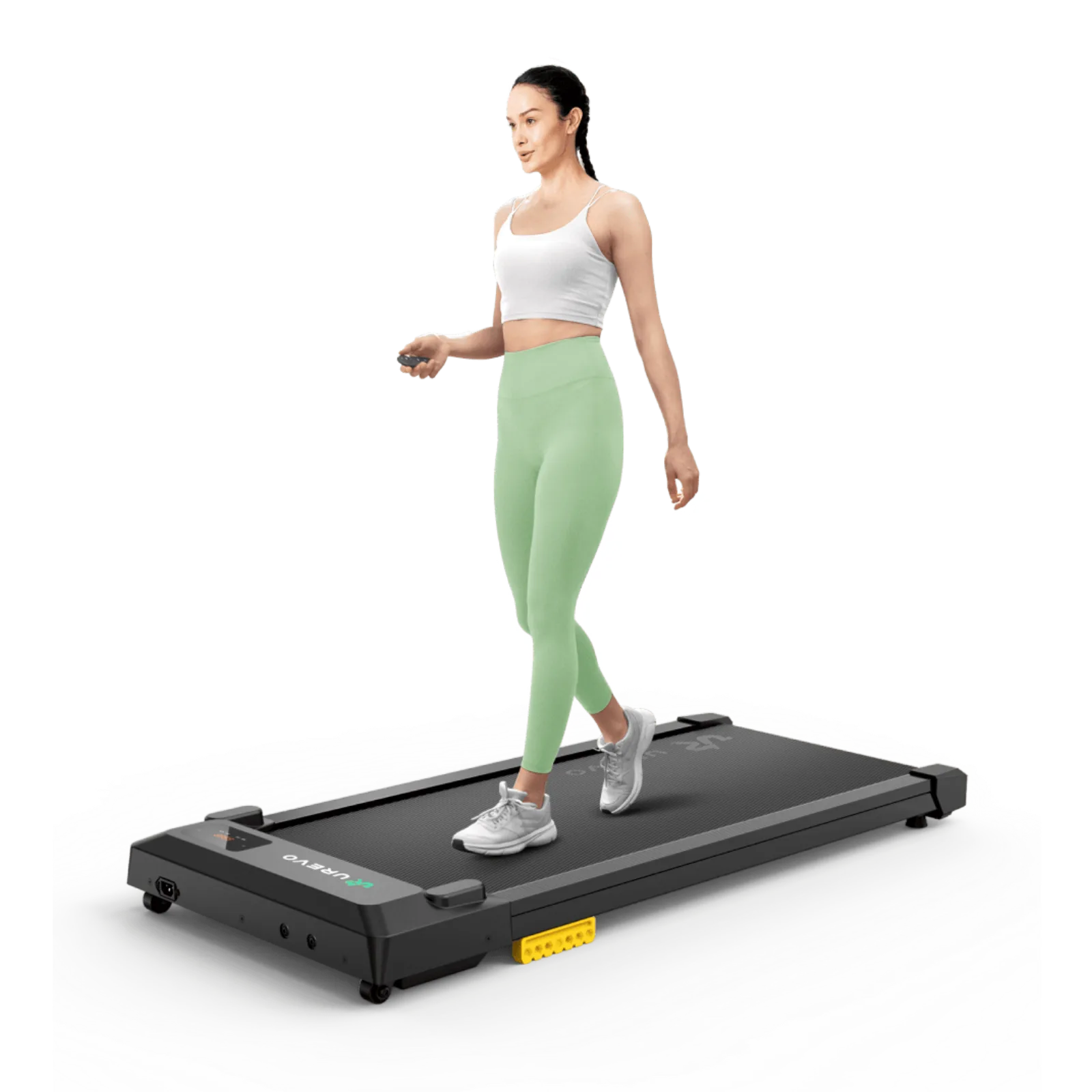
Use your stride and intended pace to choose belt space; do not shop from height alone.
Tall or long-stride users comparing compact walking pads for home use.
Published belt size may not equal usable walking surface, and desk posture changes how it feels.
Our take is based on published specifications and linked sources. We have not hands-on tested these products. Some links may earn a commission.
Your belt-size check
See the equation before the verdict.
Height is here to describe your context, not to manufacture a threshold. Enter a measured step or stride, see the exact conversion, choose your total margin, then review length and width separately.
Length heuristic
The screen clears when the belt meets the target, flags a close check when it is up to 2 in (5.1 cm) short, and misses beyond that review band.
Width lens
There is no defensible universal width cutoff for every user. The tool shows the entered width but leaves the verdict to comparison with a belt you have used comfortably and a real-unit test.
Not a certification
The editable margin and 2 in review band are WorkChoose planning heuristics. Follow the manufacturer’s instructions and test the exact setup before relying on it.
Measure before you compare
Ten natural steps beat a height formula.
Use a tape measure and the shoes and surface you will actually use. The point is to capture your pace—not to make your body fit an average.
Repeat the measurement at different speeds. A slow desk-walking pace and a purposeful walk can produce different foot travel. Keep a separate average for each one.
Home method
How to get an average
- 01Put on your usual shoes. Mark the heel of the foot you start with on a straight, level surface.
- 02Walk 10 natural steps at the target pace. Do not reach, shorten, or deliberately lengthen your walk. Mark the final heel.
- 03Measure the start-to-finish distance and divide by 10. That is your average step length from consecutive footfalls.
- 04For stride length, mark the same foot at the start and after 10 complete left-right cycles, then divide by 10. Do not call a 10-footfall measurement a stride.
- 05Repeat two or three times and average the results. Repeat the whole process for every speed you intend to compare.
Step length
One footfall to the other
If your left heel lands, then your right heel lands, that distance is one step length. A start-to-end measurement across 10 consecutive steps is usually a step-length average.
Stride length
The complete left-right cycle
If the same left heel lands again after the right foot has landed, that full cycle is one stride. For comparison, the calculator displays stride ÷ 2 as the average step-equivalent; individual left and right steps can still differ.
Manufacturer examples
Compare the usable area, not the badge.
Current product-page dimensions below are reference examples, not a ranking. Some manufacturers label this field “Walking Area” or “Running Area.”
| Model | Manufacturer-published belt / area | Source |
|---|---|---|
| WalkingPad Z1WalkingPad | 47.6 × 15.7 inWalking Area · manufacturer spec | Official product page |
| WalkingPad R3WalkingPad | 47.2 × 17.3 inWalking Area · manufacturer spec | Official product page |
| UREVO SpaceWalk E1LUREVO | 35.43 × 15.0 inRunning Area · manufacturer spec | Official product page |
| WalkingPad H1 PlusWalkingPad | 39.4 × 15.4 inWalking Area · manufacturer spec | Official product page |
Model names, variants, and measurements can change by region or revision. Verify the exact product page and manual for your purchase location. A manufacturer spec describes the product; it does not promise that it will fit every person or desk.
Want a broader comparison?
See deck height, speed, storage, controls, and belt dimensions together.
The result is one fit signal—not the whole decision.
Check deck height against your desk, total width against the desk legs, controls and cables against the room, and the manual’s placement rules. If you can, use the return policy as part of the plan and take a short, controlled test walk before making a longer work session your norm.
Keep planning
The next useful constraint
Best walking pads for tall people
Read the taller-user buying guide and its belt-length trade-offs.
Open guideBest walking pads for under-desk work
Compare current models around fit, speed, deck height, and storage.
Open guideWalking-pad comparison chart
Filter current models by belt length, width, load, speed, folding, and storage.
Open guideWalking pad desk-height calculator
Check the finished desk range after the pad raises your feet.
Open guideUnder-desk walking-pad setup guide
Measure, place, route cables, and test the whole workstation.
Open guideUnder-desk work setup hub
Follow the full decision sequence from pad to desk to workflow.
Open guideFrequently asked questions
What is the difference between step length and stride length?
Step length is the distance from one footfall to the next footfall of the other foot. Stride length is one complete left-right cycle: from one foot contacting the floor to that same foot contacting again. If you enter a stride, the calculator visibly divides it by two to create an average step-equivalent before adding your margin.
Does my height calculate the belt length for me?
No. Height is included as context because two people at the same height can walk with different step lengths, shoes, pacing, and habits. The tool uses your measured step—or half of a measured stride—plus your chosen front-and-rear margin, not a fixed height-based formula.
How much belt length should I leave at the front and rear?
Start with the neutral WorkChoose planning default of 8 inches total, roughly 4 inches at each end, then change it to match your own observation and intended pace. The result is a planning heuristic, not a safety certification or a manufacturer requirement.
What should I do with a borderline result?
Treat borderline as a prompt to check the exact model in person if possible. Walk at the pace you intend to use, look at the belt and deck—not only the outer frame—and verify the manufacturer instructions, warranty, and return policy before buying.
Can this result certify that a walking pad is safe?
No. The length screen is a WorkChoose planning heuristic, and the tool deliberately does not assign a universal pass/fail cutoff to belt width. It does not test belt tracking, motor behavior, floor conditions, controls, balance, or your ability to use a particular product. Follow the manufacturer’s instructions and stop or step off if the setup does not feel controlled.